Motivation: θ13
Neutrino has long been regarded as the mysterious particle that is perhaps massless and travels at a speed very close to the speed of light. Yet recent experiments, including the famous KamLAND experiment, has shown to us that neutrinos are very likely not massless and oscillate between three different flavors during their existence.
How were we able to deduce these facts from experimental results? The essential argument here revolves around the Mixing Matrix and the underlying Mass Eigenvalues.
Neutrinos are created and destroyed as weak eigenstates. However, as the neutrinos travel in space, they evolve according to their mass eigenstates; this process effectively mixes up the weak eigenstates of the neutrinos and allow them to turn into each other (after measurement) as they travel.
Let us first get an idea of how the mass eigenstate evolves. Here is a mass eigenstate, a, of a neutrino at time t=0, in its rest frame (a, b, c denotes the three mass eigenstates).
Mixing

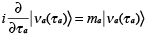

As time passes it evolves according to the Schrödinger's equation:
And at time τa, the mass eigenstate becomes:
As the neutrinos are created, they are created in the weak eigentstates, which can be written as linear combinations of the mass eigenstates. After the neutrino of weak state α travels a distance of L, in the lab frame (α, β, γ denotes the three weak eigenstates):

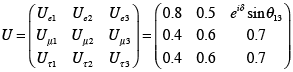
where Uκ={α, β, γ},k={a, b, c} are matrix elements of the mixing matrix U that can be specified by three mixing angles θ23, θ12, θ13 and a phase:
Mixing Probability
Now, we are able to find the probability of measuring an oscillation of the initial neutrino weak eigenstate at the distance L by the following formula:

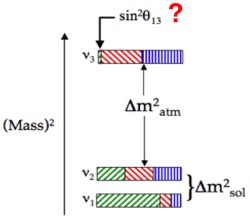
What determines the probability is then the mixing matrix elements and the squared-differences of the mass eigenvalues:
One approach is to utilize low-energy electron anti-neutrinos  . By measuring the number of such anti-particles disappeared after they have travel a certain distance from their starting point, we will be able to determine the unknown mixing angle θ13, which is the missing key for exploring CP violation in the neutrino sector.
. By measuring the number of such anti-particles disappeared after they have travel a certain distance from their starting point, we will be able to determine the unknown mixing angle θ13, which is the missing key for exploring CP violation in the neutrino sector.
Finding θ13

So, how do we produce and detect these anti-particles?





University of California, Berkeley | LBL 50A-2112 | Administrator: Shuo Wang