Design and Placement
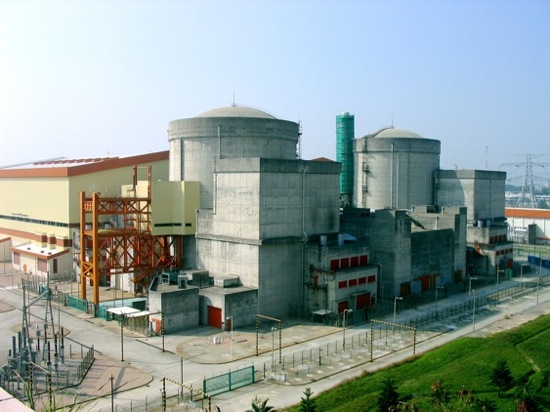
The Daya Bay Nuclear Power Complex consists of the Daya Bay Nuclear Power Plant and the Ling Ao Nuclear Power Stations, I and II. There is a twin of nuclear reactors in each power plant. The six reactors can provide a total of 17.4 GWth of thermal power.
Where to Place the Detectors?

The antineutrino,  , oscillates according to the following formula:
, oscillates according to the following formula:
The Reactor Complex is adjacent to mountains, making it relatively easy to construct tunnels to reach underground laboratory with sufficient overburden to suppress cosmics rays, thus reducing the background.
Daya Bay Nuclear Power Plant
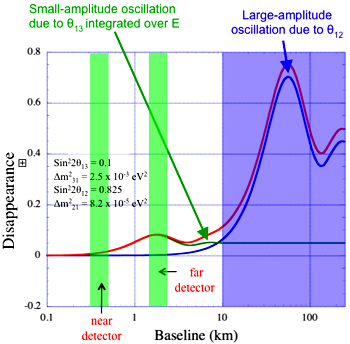
Near detector(s) is placed close to the nuclear reactor(s) to measure the flux and spectrum of for normalization; this reduces the reactor-related systematic error.
for normalization; this reduces the reactor-related systematic error.
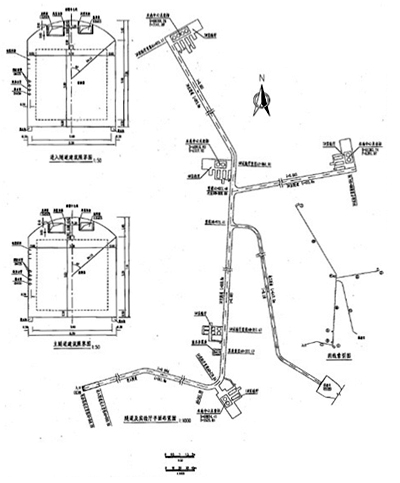
Total length of the tunnels is about 3100 m. There are three underground experimental halls. One of them is located at a distance of about 360 m from the reactors of the Daya Bay Nuclear Power Plant while the other one is positioned at about 500 m from the reactors of the Ling Ao Nuclear Power Stations. The far hall is about 1.8 km from the six reactors.
The Antieutrino Detectors that will be used for this experiment employ a three-zone cylindrical detector design:
1. Target: 20 T (0.1% Gd-Liquid Scintillator)
Eight rings of 8" low-background photomultiplier tubes.

Far detector is placed near the first oscillation maximum ( distance of the largest oscillation probability) to achieve the highest sensitivity. This also has the advantage of reducing the effect of θ12.
Tunnel Design
Antineutrino Detectors
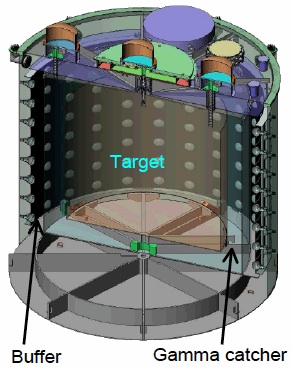
Radius = 1.55 m, Height = 1.55 m
2. Gamma Catcher: 20 T (Liquid Scintillator)
Thickness = 0.42 m
3. Buffer: 40 T (Mineral Oil)
Thickness = 0.48m
Reflectors placed at the top and bottom of the detector to maximize signal collection and even distribution.
Photocathode coverage is 5.6% (12% with reflectors)
What factors could affect the accuracy of the detectors?





University of California, Berkeley | LBL 50A-2112 | Administrator: Shuo Wang