Production
Operating nuclear reactors, through fission processes, produce large amounts of  at low energy. Generally speaking, every 3 GWth generates 6 x 10²⁰ per sec.
at low energy. Generally speaking, every 3 GWth generates 6 x 10²⁰ per sec.
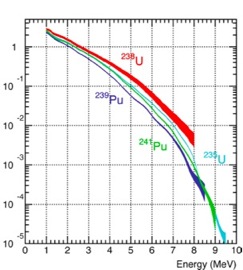
Resultant spectrum known to ~2%
Detecting Reactor Antineutrinos
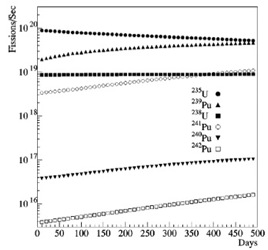
Temporal variation of the composition of nuclear fuel, leading to a time-dependent energy spectrum .
.
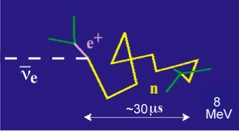
To detect produced by the nuclear reactor, a special kind of liquid called scintillator is used. When a passes through a volume of scintillator, a chain of reactions takes place and a shower of light is produced:
produced by the nuclear reactor, a special kind of liquid called scintillator is used. When a passes through a volume of scintillator, a chain of reactions takes place and a shower of light is produced:



Prompt
Delayed
Delayed
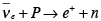
The first reaction above is the inverse β-decay reaction. This example is the chain of reactions that takes place in the Daya Bay detectors; the liquid scintillator used is a 0.1% Gd-doped liquid scintillator.
The shower of light is then collected by the photomultiplier tubes (PMTs) placed on the detector wall, producing signals that are sent to computers for analysis.
So, what do we hope to accomplish with Daya Bay?





University of California, Berkeley | LBL 50A-2112 | Administrator: Shuo Wang